
Electrostatic Attractive Beam
This theory comes from my experiments with the Miklos experiment .
Equuipment needed:
A pingpong ball
A piece of wire
70,000 volts.
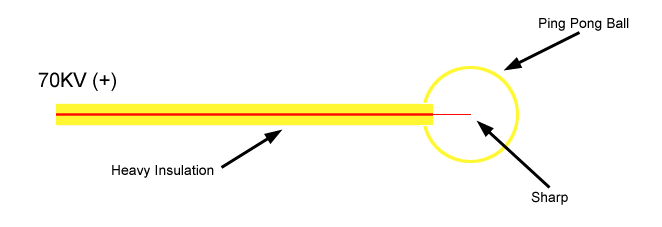
Imagine the sharp needle halfway inside the ball: The corona discharge from the tip of the needle 'reaches out' to touch a small region the ball. Pinpong ball material is quite a good insulator, so the charge on a small portion of the pingpong ball continues to rise further and further until reaching the same field-strength as the point on the needlepoint yet it is not a point, it's a... 'region'.
The lines of force on the region are extreme so all the 'electrostatic lines of force' can be drawn close together but IS NOT A POINT (like at the needle tip.)
There is no field-gradient inside the perimeter of the 'region' in the normal sense because anywhere within the 'region' has exactly the same charge as anywhere else in the 'region'.
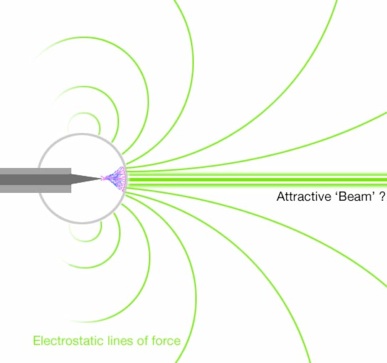
SIDE VIEW of the pingpong ball with corona discharge (blue) from a sharp needle reaching out and charging a region - as opposed to a point
It's an unusual situation. I believe the device isn't a thruster like we're used to with lifters, its an attractor.
I believe a kind of focussing effect occurs from an electrostatic field gradient (which starts at the perimeter of the 'region' and moves towards the 'not-so-charged' side of the ball) resulting in an electrostatic attractive beam.
While I've drawn the 'beam' with parallel lines, they may not be.
I did a quick test to see if a spherical object (which was free to spin) turned when positioned to the side of the device... nothing. There doesn't seem to be any kind of beam effect. Bummer.
Wait a minute. Why does the Miklos Tube device develop a 'thrust'?